Mathias
-
Bug with prefactoring and nondeterministic SQL
Read more: Bug with prefactoring and nondeterministic SQLSometimes the results of a SQL is not at all what you expected. Most of the time it is a simple error you’ve made. Very rarely is it an issue that after hours of looking at it still looks like SQL does something wrong, But it still happens. This post is about one such situation…
-
LUHNs algoritm – Three ways with SQL and PL/SQL
Read more: LUHNs algoritm – Three ways with SQL and PL/SQLHave you encountered LUHNs algorithm? I can almost guarantee it even if you’ve never heard the name before. It is part of all of our lives every single day. It is used to check that various numbers are correctly entered. From ID numbers for persons in Sweden, Greace, and Israel to credit card numbers and…
-
Waiting for direct write temp – but what file?
Read more: Waiting for direct write temp – but what file?This is essentially a not for myself for the next time I forget. It seems to be like once every other year I figure this out. It is not too easy to google for so it usually takes a bit too long. So you have identified the event “direct path read temp” or “Direct path…
-
BTB – Aggregation
Read more: BTB – AggregationIt is time for aggregating data, using the GROUP BY keyword. Hint: I will be using the emp/dept tables used by Oracle for demo in all demonstrations. I recommend Live SQL for playing, it is a great place to test SQL and learn from others. You can also sign up for a database for free (for a short time)…
-
Back to basics
Read more: Back to basicsLet’s start with baby steps We’re all very excited to read a new blog with a neat trick or a cool and complex feature or even a very useful undocumented function. However that is preaching to the choir. We do that and then we get together and complain that there is no new fresh talent in…
-
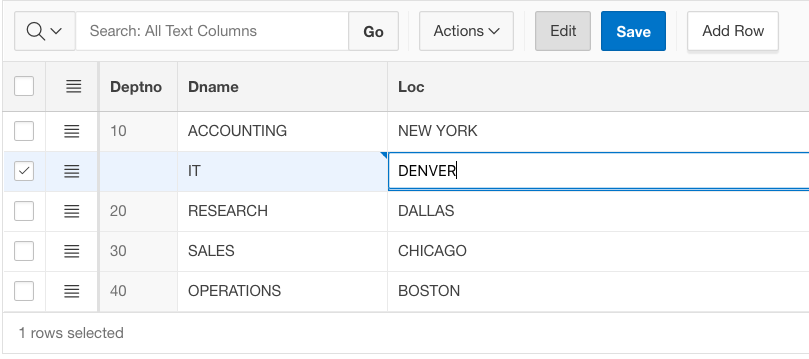
Getting t1001 in interactive grid PK
Read more: Getting t1001 in interactive grid PKHave you been plagued with the issue of getting values like t1001 show up in columns you marked as primary key in your interactive grid? In case you do not feel it is a good interface for your end users you may have found yourself spending quality time with Google looking for clues. I have had…
-
Quicktip: Don’t grant access to a synonym
Read more: Quicktip: Don’t grant access to a synonymI’ve seen this in a few places lately. When I ask the database guys there about it, they think this DDL would never work or “it does nothing but does not return an error”. Here is an example, All of the following is performed by a DBA user. We create a table, let’s call it TB.…
-
When views causes havoc
Read more: When views causes havocViews are great. They simplify design, makes code look more elegant and hides complexity. They also enables reuse by putting complex code in just one place instead of in every accessing piece of code. But… There once was a large project that has been churning away for a long time. The performance of having more…
-
Quick note on MT and applications II
Read more: Quick note on MT and applications IITalking about Multi Tenant and applications, one has to talk about the different options for sharing. It is one of the great features of multi tenant. It is a way to let one PDB – the application root – have data that can be used from other PDBs. There are three kinds that allow you…
-
Quick note on MT and applications
Read more: Quick note on MT and applicationsAre you using multi tenant with multiple containers and you’re not familiar with application containers? It allows you to set up PDBs that belong to a CDB-like PDB that “owns” them. With that you can install applications (database objects) in the container, and then decide into which PDB to install, upgrade or patch that particular application,…
Subscribe
Sign up with your email address to receive our weekly news
Latest news
- 23ai 4000+ columns
- 23ai Lock-free reservations
- Troubleshooting conversion errors
- 23ai Syntactic sugar – IF [NOT] EXIST
- 23ai Select without FROM
Categories
- Alert Log (4)
- APEX (25)
- AQ (1)
- Article (1)
- Back To Basics (2)
- Blogging (10)
- Books (1)
- Bug (4)
- Business (1)
- Challenge (2)
- Commit (2)
- Database (16)
- DBA (24)
- Docker (4)
- EXA (1)
- Humor (1)
- I/O (2)
- ITL (1)
- JoelKallmanDay (1)
- Licensing (3)
- Machine Learning (1)
- MultiTenant (2)
- New Stuff (2)
- OOW (12)
- Oracle (36)
- Oracle Cloud (7)
- Oracle DB 23ai (3)
- Oracle Developer Tools (3)
- ORDS (10)
- OTN (1)
- Partitioning (6)
- Performance (19)
- Perl (1)
- PL/SQL (7)
- Presenting (2)
- Property Graph (1)
- Python (2)
- RSS (2)
- Security (3)
- SQL (34)
- SQL Developer (3)
- SQLcl (5)
- ThanksODC (1)
- Uncategorized (6)
- Undo (1)
- Versioning (1)
- Virtualization (2)
- Visual Code (4)
- Wallet (3)
- XML (4)